Detecting a Brute-Force Attack Using an Intrusion Detection System (IDS)
Case Study Overview
An organization hosts a public-facing web application and SSH service for remote administration. The security team has deployed a Network Intrusion Detection System (NIDS) to monitor inbound and outbound traffic. The IDS is configured with signature-based and anomaly-based detection rules.
During routine monitoring, the IDS begins generating alerts indicating suspicious authentication activity.
Incident Background
- Environment: Corporate network with public web and SSH access
- Security Control: Network-based IDS (e.g., Snort / Suricata)
- Objective: Detect unauthorized access attempts before compromise
Attack Scenario
An external attacker initiates a brute-force login attack against the organization’s SSH service.
Attack Flow
- The attacker scans the network to identify open ports.
- Port 22 (SSH) is discovered and targeted.
- Multiple failed login attempts are sent from a single IP address.
- The attacker rotates usernames to evade simple lockout controls.
IDS Detection
The IDS detects:
- High volume of failed SSH login attempts
- Repeated authentication requests in a short time window
- Abnormal traffic patterns compared to baseline behavior
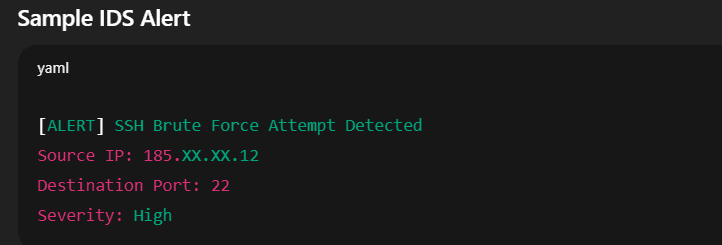
Sample IDS Alert
[ALERT] SSH Brute Force Attempt Detected
Source IP:185.XX.XX.12
Destination Port:22
Severity:High
Security Impact
If undetected, the attack could lead to:
- Unauthorized system access
- Privilege escalation
- Lateral movement within the network
- Data exfiltration or service disruption
Response Actions
- SOC analyst investigates IDS alerts
- Source IP is blocked at the firewall
- SSH access is restricted to trusted IPs
- Multi-factor authentication (MFA) is enforced
- Logs are reviewed for successful login attempts